
Freedom Dental Implants · Louisville, KY
Implant-supported dentures in Louisville, KY
If your denture feels like a compromise, discover how one-piece dental implant support could help you feel more secure.
Implant-supported dentures use dental implants as anchors instead of relying only on the gums, suction, or adhesive. At Freedom, we evaluate mini implant o
Freedom Dental Implants · Louisville, KY
If your denture feels like a compromise, discover how one-piece dental implant support could help you feel more secure.
If you’ve been comparing implant denture options online, you may have noticed that the terminology gets confusing fast. Snap-in dentures, implant dentures, fixed bridges, roundhouse bridges, All-on-X, and the list goes on… Some names sound interchangeable, while others describe very different ways of replacing a full set of teeth.
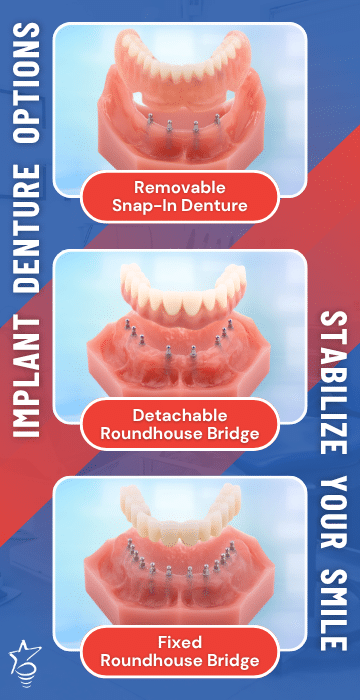
At Freedom Dental Implants, “implant dentures” simply means a full set of replacement teeth held securely in place by dental implants. Dr. Ackerman offers three main options: a removable snap-in denture, a detachable roundhouse bridge, and a fixed roundhouse bridge. Some options are removable, while others stay in place, and each comes with its own level of stability and care routine.
This page is here to make those differences easier to sort out. We’ll compare the three options so you can get a better sense of which one may fit your daily life, preferences, and budget. If one stands out, you can follow the link to its dedicated page for a closer look at how that treatment works.
The best implant denture for you depends on more than its appearance. Think about how much maintenance you want to handle at home, whether you want to remove your teeth yourself, and how much stability you are looking for. This side-by-side comparison shows how snap-in dentures and roundhouse bridges differ.
| Feature | Snap-In Denture | Detachable Roundhouse Bridge | Fixed Roundhouse Bridge |
| Who removes it? | You, for daily cleaning | Dr. Ackerman, at your maintenance visits | No one! It stays in place at all times |
| Daily cleaning | Take it out and clean it like a denture, then clean around the implants | Brush in place and clean underneath with a water flosser | Brush in place and clean underneath with a water flosser |
| Upper palate coverage | Leaves more of the palate open than a traditional denture | Your upper palate is exposed for improved taste and sensation | Your upper palate is exposed for improved taste and sensation |
| Typical number of implants | 4-6 for the lower, 6-8 for the upper; based on your CBCT scan | 6-10, based on your CBCT scan | 10-12, based on your CBCT scan |
| Routine upkeep | O-ring replacement about once a year | Professional cleanings | Professional cleanings |
| Price per arch | $7,500 | $16,500 | $16,500 |
If affordability matters most, a snap-in denture may make the most sense. At $7,500 per arch, a snap-in denture is the most affordable option. Detachable and fixed roundhouse bridges are $16,500 per arch, so the difference can be significant if you’re paying out of pocket.
If you want teeth that stay in place, a bridge may be more appealing. With a snap-in denture, you remove the teeth yourself for cleaning. A detachable bridge stays in place day to day, and only Dr. Ackerman removes it, while a fixed bridge is cemented in place.
If you want your teeth to stay in place all the time, we’d recommend a fixed roundhouse bridge. It is cemented in place, so you do not remove it at home. You still need to clean carefully around and underneath the bridge and come in for professional maintenance.
If easier professional maintenance matters to you, a detachable bridge has an advantage. Dr. Ackerman can remove it in the office for cleaning, adjustments, or repairs, which gives her more flexibility than with a cemented bridge.
If maximum stability matters most, the fixed roundhouse bridge stands out. Because it is cemented in place, it offers the greatest stability among our full-arch options and feels the most like having natural teeth again.
If you have arthritis or limited hand strength, think about which cleaning routine will be easier for you. A snap-in denture must be removed and reinserted, while a bridge stays in place and requires cleaning underneath. For some patients, one routine may feel much more manageable than the other.
Your treatment plan depends on whether you have teeth now and their condition. Some patients already wear dentures and can move straight to implants, while others may need extractions first. And if some of your natural teeth are still healthy, Dr. Ackerman will make sure they stay in place.
If your teeth have already been removed and the bone has healed, treatment can often move more quickly because there is no extraction stage to work through first.
In some cases, we can convert your current denture into a snap-in denture if it is in good condition and has enough room for the implant attachments. Dr. Ackerman can place the implants and connect the denture in the same appointment, so you leave with implant-stabilized teeth. If you need or want a new denture made, we can handle that too.
Some patients want to upgrade from an acrylic denture to an implant-supported roundhouse bridge. If that system is right for you, Dr. Ackerman will place your implants and attach a temporary bridge at the same visit. Once the lab crafts your custom roundhouse, you’ll come back in for a final fitting.
Dr. Ackerman never assumes that every remaining tooth needs to come out. She removes only teeth that cannot reasonably be saved and plans your tooth extractions with future implant treatment in mind.
After extraction, the sites typically need to heal for about three months before we place the implants. You can wear a temporary denture during that time, so you don’t have to go without teeth while you heal. Once the bone is ready, Dr. Ackerman places the one-piece implants and attaches either your snap-in denture or a temporary bridge that same day.
You may not need to replace an entire arch at all. If some of your natural teeth are still healthy enough to keep, Dr. Ackerman can build your treatment plan around them rather than removing teeth unnecessarily.
That could mean using an implant-supported bridge to replace several missing teeth or creating a more customized full-mouth reconstruction that combines different implant restorations in different areas of the mouth. The result is a highly customized treatment plan based on what your mouth actually needs.
You don’t have to replace both arches at the same time, and you don’t have to use the same type of restoration on the top and bottom. Dr. Ackerman can plan treatment around the arch that is giving you the most trouble first, then build from there.
Lower dentures are often the hardest to keep stable because they have less surface area to rest on and no palate to help create suction. That is why many patients first ask about stabilizing a loose lower denture with implants.
Stabilizing a loose lower denture is one of Dr. Ackerman’s favorite treatments because patients notice the improvement right away. Lower dentures can be especially difficult to keep in place, and many people come to us after years of avoiding foods they no longer feel comfortable eating. With one-piece implants, Dr. Ackerman can place the implants and attach a snap-in denture during the same visit, so patients often leave with a lower denture that feels much more secure. For many, that immediate change makes the lower arch a natural place to start, with the upper arch planned for later when the time feels right.
The upper jaw usually needs more implants to stay secure and stable.
In some cases, placing implants farther back in the upper jaw may also require a minimally invasive sinus lift to create enough bone for support.
One advantage of an implant-supported upper denture is that it leaves more of the palate uncovered than a traditional full upper denture. That openness can make the prosthesis feel less bulky and helps you taste food more fully.
If you’ve been researching implant dentures, you’ve probably come across a long list of terms. Offices and manufacturers describe similar treatments differently, which can make it hard to compare your options. Here’s how some of the most common terms line up with the treatments we offer at Freedom Dental Implants.
These names all describe a removable denture that attaches to dental implants. Small attachments inside the denture snap onto the implants and hold it steady while you eat and speak. You take it out at night to clean it. At our office, we call this a snap-in denture.
These terms describe a roundhouse bridge attached to a set number of implants. All-on-4 uses four traditional dental implants, while All-on-X leaves the number of traditional implants open.
Fix-on-six uses about six mini dental implants to secure the full arch.
Our detachable and fixed roundhouse bridges are also full-arch implant restorations, but Dr. Ackerman does not start with a preset implant count. Instead, she uses your CBCT scan to decide how many implants your jaw needs and where to place them.
The term hybrid denture usually describes a full-arch restoration that stays in place on dental implants but can be removed by the dentist when needed. At Freedom Dental Implants, we refer to this as a detachable roundhouse bridge.
You may see the term “permanent dentures” online, but we tend not to use it at Freedom Dental Implants. No dental restoration lasts forever, and we prefer to be clear about that from the beginning.
“Permanent dentures” can mean different things depending on who is using the term. Some people use it to describe teeth that stay in place all the time, while others are referring to the dental implants themselves, which remain in the jaw even if the restoration can be removed.
At Freedom Dental Implants, we use more specific terms. Our fixed and detachable roundhouse bridges are both supported by dental implants and stay in place during daily life. The fixed bridge is cemented in place, while Dr. Ackerman can remove the detachable bridge for maintenance when needed. Both are meant to provide a long-term replacement for a complete arch of teeth.
This phrase can mean different things depending on the office. At Freedom Dental Implants, it means Dr. Ackerman places your one-piece implants and attaches a snap-in denture or temporary bridge during the same visit, so you leave with teeth. It does not mean removing your teeth and placing implants in the same appointment. If you need extractions, Dr. Ackerman lets the sites heal for about three months first so your implants have solid bone to anchor into.
Implant dentures go by many names, and it can be hard to tell which terms describe the same thing and which refer to a different treatment. At Freedom Dental Implants, we’ll help you sort through the terminology and focus on what actually matters: how each option feels, how you maintain it, what it costs, and whether it fits your needs.
At your free consultation, Dr. Ackerman takes and reviews your CBCT scan, examines your mouth, and discusses your goals. With that information in mind, she helps you choose the best implant denture option for you. Ready for the next step? Schedule a free consultation today!
Before your visit
How long your implant denture lasts depends on the type you choose, the materials used to craft it, and how well you care for it. A removable snap-in denture typically lasts about 10 years, while detachable and fixed roundhouse bridges generally last around 15 to 20 years—or even longer. The fixed roundhouse tends to last the longest because of its exceptional stability and cemented design.
The better you care for your implant denture, the longer it can last. Regular cleanings, good home care, and replacing worn components, such as the O-rings in a snap-in denture, will help you get the most from your investment.
There is usually a short adjustment period. Most patients start feeling more comfortable within a few days to a couple of weeks as they adjust to the fit, bite, and cleaning routine. A snap-in denture may feel different because it locks onto implants, while a roundhouse bridge stays in place and can feel more like having your own teeth again. Give yourself a little time to adjust, and let us know if anything feels off so we can check the fit.
Often, yes. A snap-in denture can be a great place to start if you want more stability without jumping straight to the cost of a roundhouse bridge. Later, if you want teeth that stay in place or are ready for a different level of stability, Dr. Ackerman can evaluate whether an upgrade makes sense.
The exact plan depends on your bone, the number and position of your implants, and the type of bridge you want. Starting with a snap-in doesn’t necessarily lock you into that choice forever. You have flexibility as your needs and budget change.
One of the biggest benefits of implant dentures is enjoying foods that may have been difficult with loose traditional dentures. With a stable snap-in denture or roundhouse bridge, patients can eat a much wider variety of foods, including meats, vegetables, and other foods that require more chewing power. Once your teeth feel secure, eating becomes much less complicated and much more enjoyable.
Because of its unmatched stability, a fixed roundhouse bridge often gives patients the most peace of mind at mealtimes.
Real patients. Personal care.
Implant dentures use dental implants to support a full arch of replacement teeth. Depending on the option you choose, your teeth may snap in and out for cleaning or stay secured in place throughout the day. The smile shown here highlights how implant support can help create a complete, natural-looking smile.
Our Louisville team offers snap-in dentures as well as detachable and fixed roundhouse bridges. Schedule a free consultation to compare options and see which implant denture fits your needs.
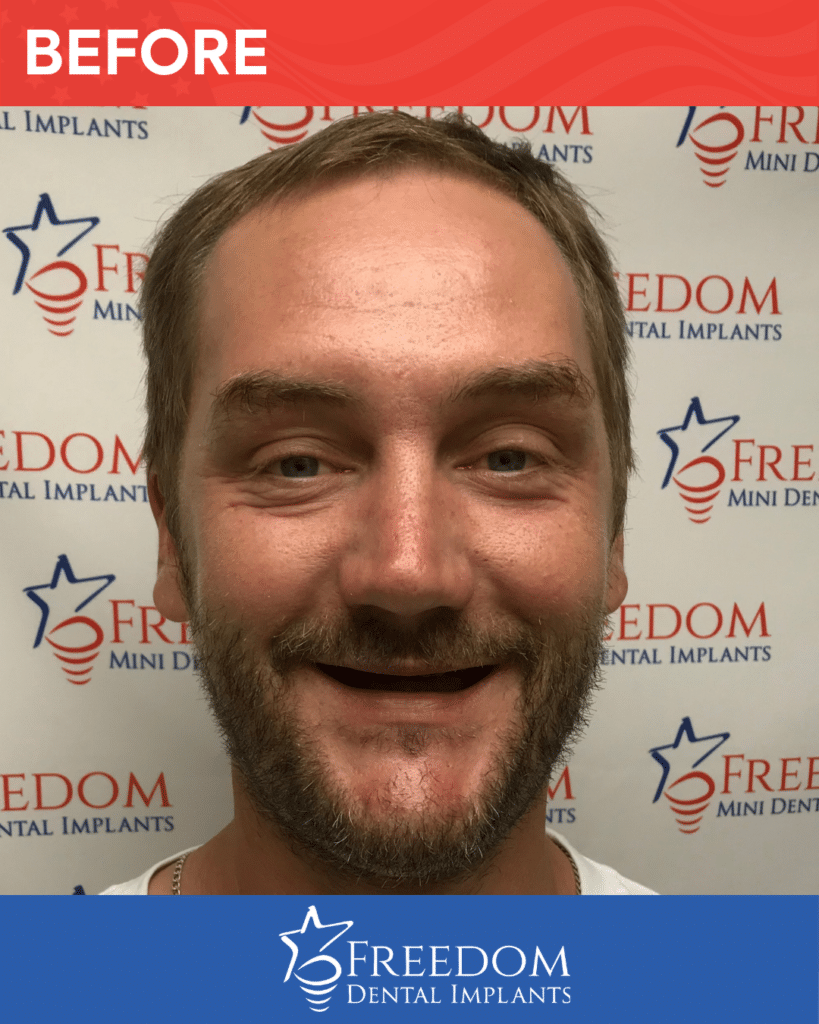
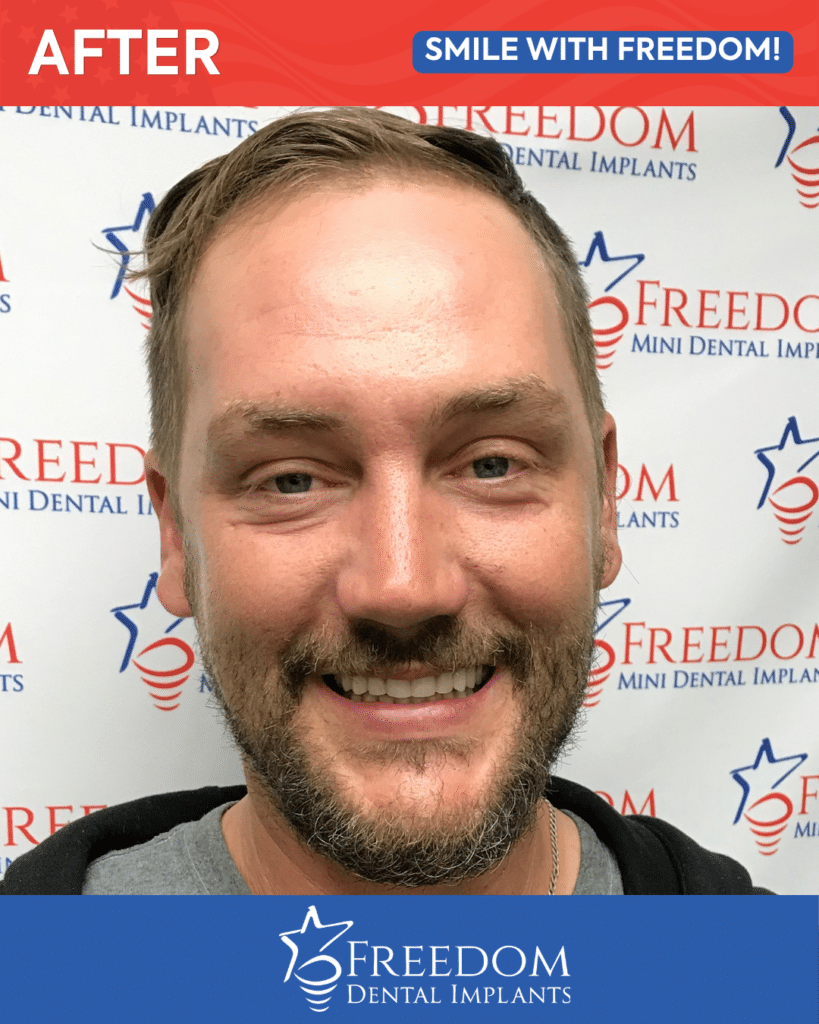
A smile from our practice. Individual results vary. Photos show the patient’s own starting point and result.
Patient education

Explore how treatment options, transparent pricing, and financing can help make dental implants fit your budget.

Learn how to clean your implant-supported denture, care for attachments, and maintain a daily hygiene routine.

Explore how mini implants support removable snap-in dentures and what to expect from treatment and daily care.

We are a family-run practice, and you see Dr. Regan Ackerman from your first consultation through treatment. We recommend care for the teeth that need it and preserve healthy teeth whenever possible. We use both mini and conventional-sized one-piece implants, choosing the size and restoration that fit your mouth.
Contact us today to arrange a free consultation.
Let’s talk about your smile
Tell us what is holding you back. We will explain your options and help you take the next step with confidence.
Request a free consultation Call (502) 937-4930