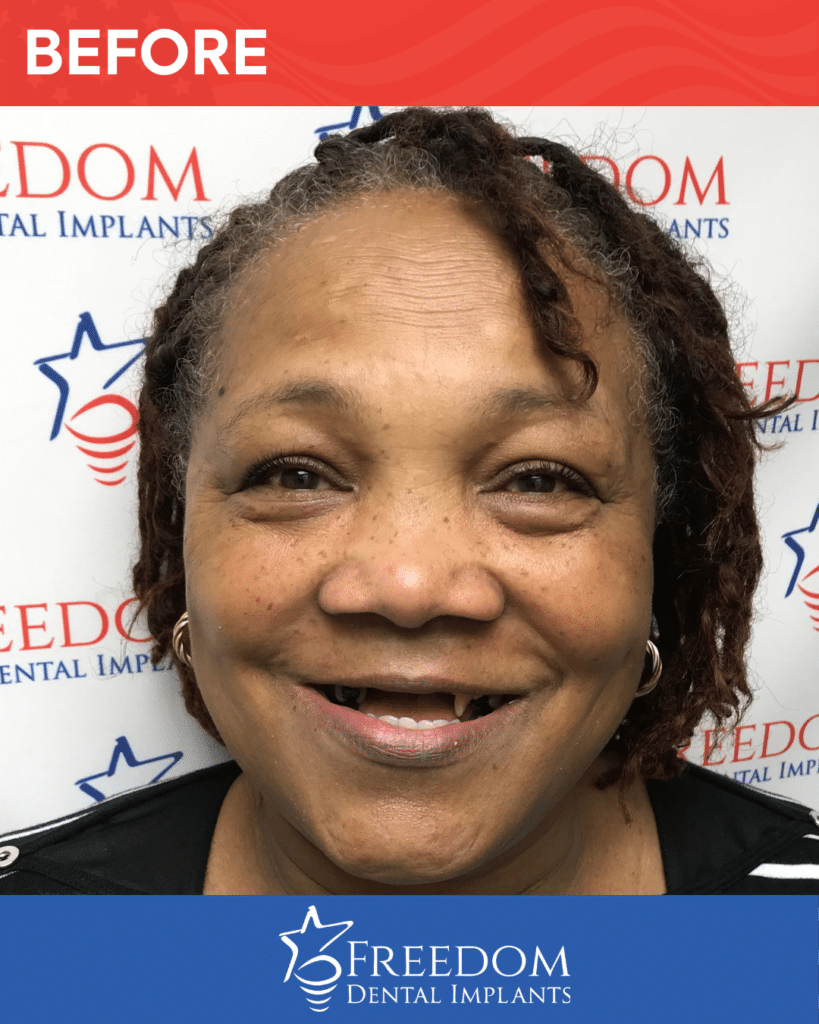
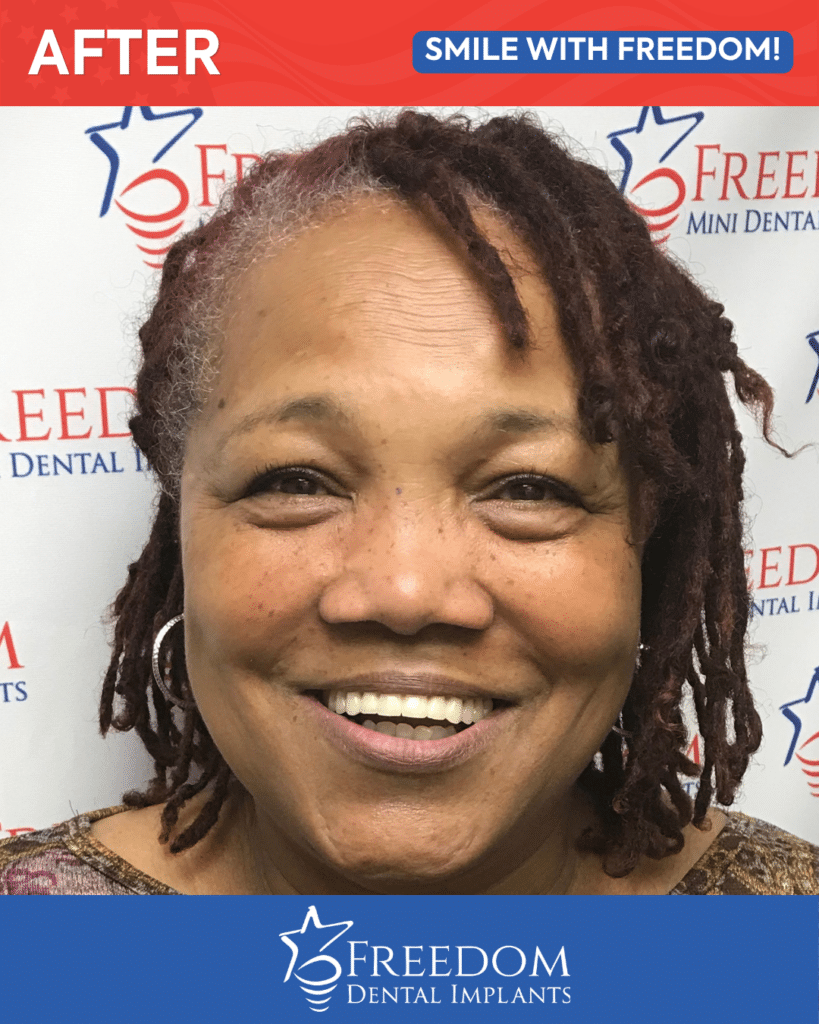
Replacing a full arch of teeth does not necessarily mean living with a denture you take out every night. A roundhouse bridge uses dental implants to support a full row of replacement teeth that stays in place while you eat, sleep, and go about your day. For patients who have spent years taking out a denture or are preparing to replace failing teeth, having teeth that stay put can open up an entirely different way to think about tooth replacement.
At Freedom Dental Implants, replacing missing teeth is our focus. Dr. Regan Ackerman has placed roughly 10,000 dental implants and provides several full-arch options, including detachable bridges and fixed roundhouse bridges. Because each option works differently, she considers what you need from your replacement teeth as well as the bone available to support them before recommending a treatment.
What Is a Roundhouse Bridge?
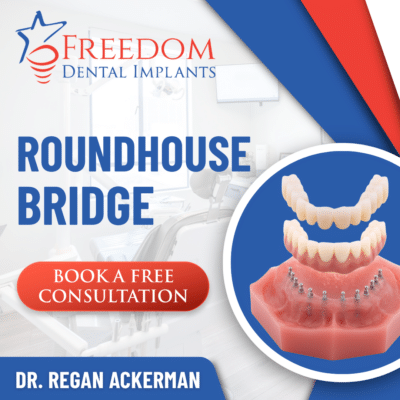
A roundhouse bridge replaces a full upper or lower arch of teeth with one full-arch restoration. Its continuous design follows the shape of the dental arch from one side of the mouth to the other. Dr. Ackerman places multiple dental implants throughout the jaw to support the restoration, creating a stable foundation for the complete row of replacement teeth.
The term “roundhouse” comes from the bridge’s shape. Natural teeth follow the curve of the jaw, forming a U- or horseshoe-shaped dental arch. A roundhouse bridge recreates that arrangement across the upper or lower jaw. From the front, you see a complete row of replacement teeth. Viewed from above or below, the bridge curves around the jaw much like the natural dental arch it replaces.
That curved design helps the bridge function as a complete arch of replacement teeth. The restoration positions the replacement teeth along the dental arch. The implants underneath provide support at planned locations across the jaw. Because those implants support one full-arch prosthesis, chewing forces can be shared across multiple implant supports. The number, size, and placement of the implants will depend on your jawbone, anatomy, and treatment plan.
A roundhouse bridge shares some qualities with an implant denture. Both replace a full arch of teeth and are supported by dental implants. The key difference is whether you remove the restoration yourself. A typical implant denture, often called a snap-in denture or implant-retained overdenture, comes out for daily cleaning. A roundhouse bridge stays secured to the implants, so it remains in your mouth. Depending on the type of bridge you choose, Dr. Ackerman can remove the bridge when necessary for maintenance or repairs.
What Are the Benefits of a Roundhouse Bridge?
A roundhouse bridge may answer many of the concerns you have about replacing an entire arch of teeth. Maybe you are tired of a removable denture, worried about your teeth shifting while you eat, or looking for replacement teeth that require less day-to-day management. These concerns often shape what patients want from their replacement teeth.
Patients may choose a roundhouse bridge because they want:
- Teeth they don’t have to remove every night: The bridge stays in place 24/7, which eliminates the routine of taking out and storing a removable denture overnight.
- More stability when they eat: Implant support helps prevent the rocking and lifting that patients may experience while chewing with a loose denture.
- More confidence while speaking: Patients don’t have to worry about a loose denture shifting while they talk, laugh, or share a meal.
- Freedom from denture adhesives: The dental implants we place throughout the jaw support the bridge, so patients don’t need adhesives to keep their teeth in place.
Am I a Candidate for Dental Implants?
You may have been told you don’t have enough bone for dental implants or that you would need a bone graft before treatment. Failing teeth and gum disease can raise questions about your options, too. But dental implant candidacy can depend on the type and size of implant being considered.
At Freedom Dental Implants, Dr. Ackerman uses dental implants in several diameters. She uses a Cone-Beam Computed Tomography (CBCT) scan to evaluate the available bone and consider which implant size can provide the support needed for your roundhouse bridge.
This evaluation is especially beneficial for patients concerned about candidacy and bone loss. Conventional implants are wider and require enough space to accommodate their diameter. Mini dental implants are less than 3 millimeters in diameter, giving Dr. Ackerman a narrower option when the available bone cannot accommodate a wider implant. In some cases, she can place these smaller implants without first building up the area with a bone graft.
Limited bone, then, does not automatically answer the candidacy question. The condition of your remaining teeth and gums, and available bone support your roundhouse bridge requires, still affect the treatment plan. Together, these factors help Dr. Ackerman determine if a roundhouse bridge is a suitable treatment for you.
How Do I Care for My Roundhouse Bridge?
A roundhouse bridge stays in your mouth, so caring for it is different from cleaning a traditional denture. You won’t take the bridge out at night or remove it to clean it. You will, however, need to clean it as thoroughly as you would your natural teeth.
Brush your bridge twice a day with a soft-bristled toothbrush and nonabrasive toothpaste. Pay close attention to the gumline and the areas around your implants. Food and plaque can also collect underneath the bridge, where a regular toothbrush may not reach.
To clean those spaces, we recommend tools such as a water flosser, interdental brush, or a floss threader. The best method depends on the design of your bridge; we can show you how to reach these areas without irritating the surrounding gum tissue.
Home care is only part of maintaining a roundhouse bridge. At your recommended dental visits, the team can clean hard-to-reach areas and evaluate the gums and implants supporting your bridge. Our team can see how those tissues respond over time and whether your current cleaning routine reaches the areas that need the most attention. If certain spaces are collecting buildup, your dental team can show you how to clean them more effectively at home.
What Would You Change About Your Teeth?
Replacing all your teeth should solve problems, not give you a new set of routines to manage. If removing your teeth at night, reaching for adhesive, or worrying about movement has become familiar, a roundhouse bridge gives you another option.
At Freedom Dental Implants in Louisville, Dr. Regan Ackerman can help you explore what it would take to replace your teeth with a fixed full-arch bridge. Schedule your free consultation and start planning for teeth that stay where they belong.