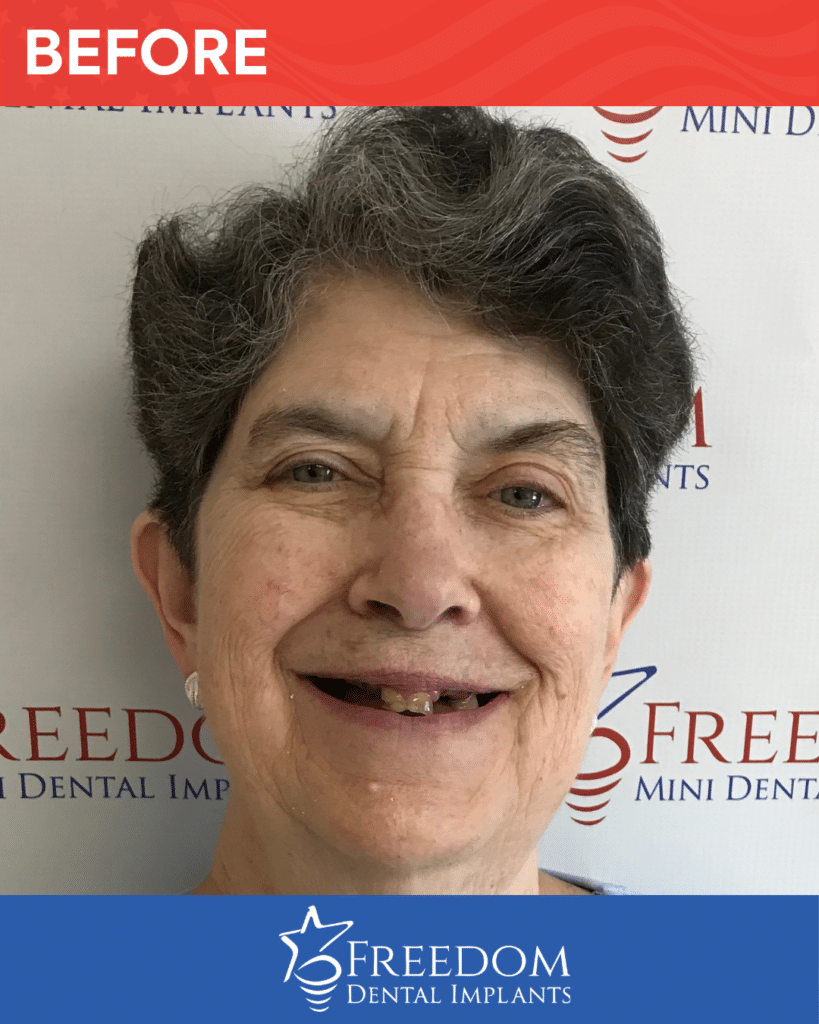
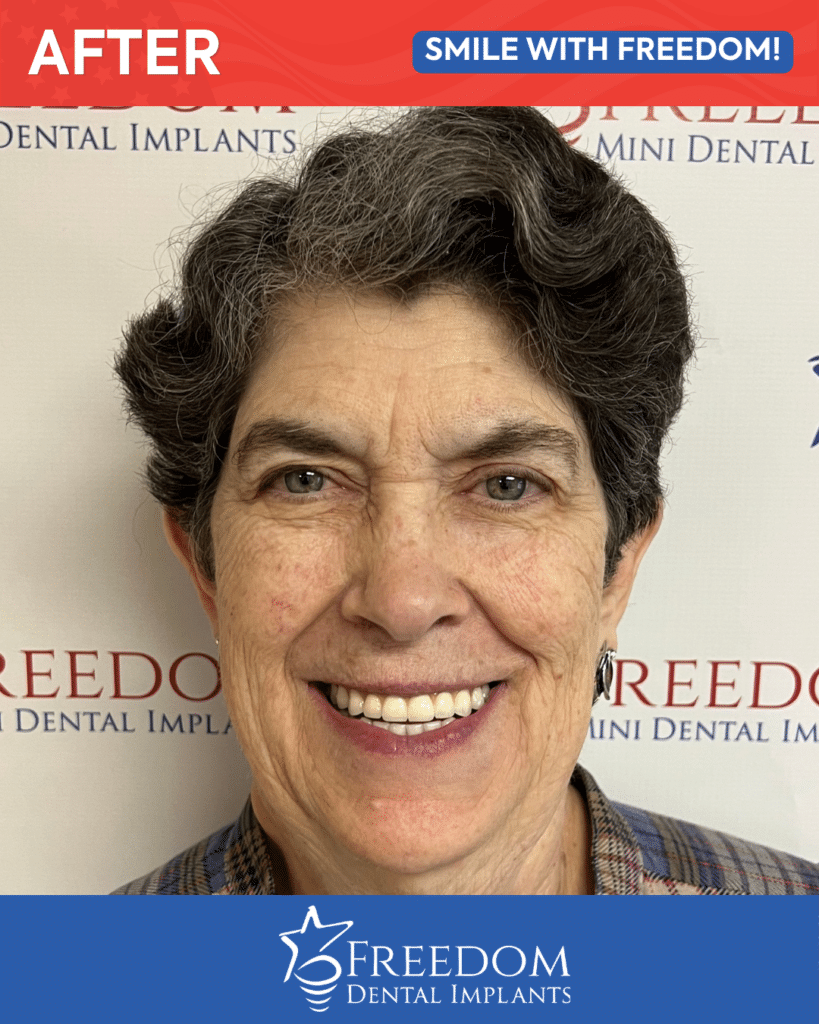
Full-mouth reconstruction can sound like one enormous procedure: every tooth comes out, and everything starts over. In reality, your mouth may present a much less uniform problem. One tooth may still be healthy enough to keep. Several missing teeth may leave a gap on one side. A loose denture may make it difficult to eat, while damaged teeth elsewhere require attention of their own.
Trying to solve each problem separately can lead to a string of treatments without a clear endpoint. Full-mouth reconstruction organizes the work around what you have, what you have lost, and how your replacement teeth need to function together.
At Freedom Dental Implants in Louisville, KY, Dr. Regan Ackerman focuses full-mouth reconstruction on tooth replacement. Depending on your needs, your treatment plan may combine implant-supported crowns or bridges with a snap-in denture or full-arch replacement teeth. Different parts of your mouth may require different solutions, but each treatment serves the same larger purpose: rebuilding enough stability and function for you to eat comfortably again.
What Does Full-Mouth Reconstruction Include?
Full-mouth reconstruction describes the complete treatment plan, not a specific dental procedure. Your treatment plan can bring together several forms of tooth replacement, based on how many teeth you have lost, where they are missing, and what remains throughout your mouth.
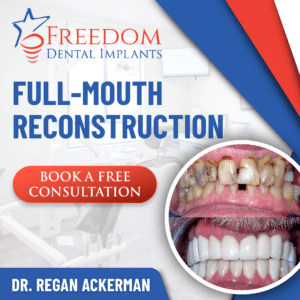
At Freedom Dental Implants, Dr. Ackerman can draw from several treatment options as she plans how to rebuild your teeth:
- Single-tooth implant and crown: A dental implant replaces the missing tooth root, while a custom crown attached to the implant replaces the visible tooth.
- Implant-supported bridge: Two or more dental implants can anchor a dental bridge that fills a larger gap with multiple connected replacement teeth.
- Snap-in denture: Dental implants anchor a removable implant denture, helping the denture stay firmly seated during everyday activities such as eating and speaking. You can still remove it yourself to clean it.
- Detachable full-arch bridge: A full arch of replacement teeth attaches to dental implants and remains in place during daily use. Your dentist removes the bridge when necessary for professional care or maintenance.
- Fixed full-arch bridge: Dental implants support a full-arch roundhouse bridge designed to stay in your mouth continuously and function as your everyday teeth.
- Traditional denture: A removable prosthesis replaces all of the teeth along the upper or lower arch and rests directly over the gums.
Preparing Your Mouth for Tooth Replacement
Full-mouth reconstruction often begins before Dr. Ackerman places a replacement tooth. If a tooth cannot be preserved, she can remove it and prepare the site for the restoration that will replace it. When bone loss affects an implant site, she can perform a bone graft to rebuild the support needed for placement.
Dental implants in the upper back jaw can require a different type of preparation. The maxillary sinuses sit above the upper premolars and molars. After tooth loss, there may be too little bone beneath the sinus to support an implant. Dr. Ackerman performs sinus lifts to increase the available bone in this area when necessary.
Extractions, bone grafting, and sinus lifts are not separate from reconstruction when needed for treatment. They become part of the process of moving from damaged or missing teeth to the final restorations planned for each area.
Mini Dental Implants and One-Piece Dental Implants
Replacing many teeth can already involve several procedures and stages of treatment. The type of dental implant used can affect how much additional treatment becomes part of the plan. At Freedom Dental Implants, we use one-piece implants in a range of diameters, including mini dental implants.
Mini implants and one-piece implants describe different characteristics of a dental implant, which is important to understand when comparing your options. Mini implants are narrow, measuring less than 3 millimeters in diameter. They are also one-piece implants, meaning the implant body and the abutment that supports the restoration are together in a single unit. One-piece implants are also available in larger diameters, so not every one-piece implant is a mini implant.
Mini implants can provide another option for some patients who have experienced bone loss. Over time, the remaining jawbone may be too narrow to support a wider implant without bone grafting. Because mini implants have a smaller diameter, they may fit within the available bone. For appropriate patients, this can reduce the need for additional surgery. Placement typically requires only a small pilot opening, helping keep the procedure less invasive.
The one-piece design can simplify treatment in another way. A conventional two-piece implant has a separate implant body and abutment that must be connected during treatment. A one-piece implant incorporates both into a single component. The crown, bridge, or denture is still a separate restoration, but the implant does not require a separate abutment connection.
Planning Your Full-Mouth Reconstruction
Dr. Ackerman begins planning your full-mouth reconstruction during your free consultation. We hear concerns like, “I’m missing so many teeth that I don’t know what can be done anymore,” “The teeth I have left are breaking down,” and “I can’t chew the way I used to.” You may already know how much your teeth affect your daily life without knowing what treatment you’ll need. The consultation gives Dr. Ackerman the information she needs to answer that part.
She examines your teeth and takes a CBCT scan, or cone-beam computed tomography. This type of X-ray creates three-dimensional images of your teeth, jawbone, and surrounding structures. When dental implants are part of a full-mouth reconstruction, Dr. Ackerman can use the scan to evaluate potential implant sites, measure available bone, and plan implant placement.
Once the evaluation is complete, Dr. Ackerman goes over your treatment plan with you. Full-mouth reconstruction often happens in stages, and the timeline is different for every patient. Some procedures need to happen before others, and healing time may be necessary between appointments. Your plan lays out that sequence, so you know what treatment we recommend, when each stage will happen, and what you are working toward.
Your free consultation also includes a review of the cost of treatment and available financing options. You can go over the plan, ask questions, and understand the financial side of care before deciding how you would like to proceed.
Let’s Start Planning Your Full-Mouth Reconstruction
Have you stopped feeling comfortable with your teeth? Does it seem like there is always another tooth that needs attention? Are you trying to manage missing teeth, damaged teeth, or a denture that no longer works well for you? Have you put off treatment because you were not sure where to begin?
Full-mouth reconstruction can address several dental needs within one coordinated plan. During a free consultation at Freedom Dental Implants, Dr. Regan Ackerman will evaluate what you are dealing with and explain what rebuilding your teeth could involve. You can review the recommended treatment, timeline, cost, and financing options before deciding how you want to proceed.
Contact Freedom Dental Implants in Louisville, KY, to book your free consultation.