
Freedom Dental Implants · Louisville, KY
Oral Surgery in Louisville, KY
Dr. Ackerman provides implant-focused oral surgery with a careful, conservative approach that includes extractions, bone grafting, sinus lifts, and one-piece implant placement.
Freedom Dental Implants · Louisville, KY
Dr. Ackerman provides implant-focused oral surgery with a careful, conservative approach that includes extractions, bone grafting, sinus lifts, and one-piece implant placement.
Oral surgery is part of what we do every day at Freedom Dental Implants. Placing an implant in the jaw is oral surgery, and sometimes building the right foundation for that implant involves an extraction, bone grafting, or a sinus lift. Dr. Regan Ackerman has placed thousands of dental implants. Her experience has taught her not to treat every mouth the same way, even when the end point is the same: strong support for new teeth.
We believe every step should earn its place in your treatment plan. If a tooth is worth keeping, we want to keep it. If an extraction site will give us better bone after it heals, we are willing to wait before placing the implant, and if the bone needs additional support, we have ways to address it. Some approaches to implant dentistry emphasize how much can be accomplished in a single day. We focus on giving your implants the foundation they need for years ahead.
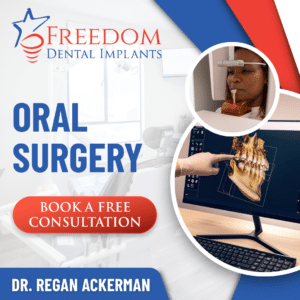 Dental implant placement is considered oral surgery because Dr. Ackerman creates a small opening in the gum and places the implant directly into the jawbone. For some patients, implant placement is the only surgical procedure involved. For others, preparing the area for an implant requires additional treatment. Your treatment depends on the condition of your teeth, the bone available at the implant site, and the type of replacement teeth you need.
At Freedom Dental Implants, we have a cone-beam computed tomography (CBCT) scanner in our office to help Dr. Ackerman plan these procedures. A standard dental X-ray produces a flat, two-dimensional image. CBCT creates a detailed 3D view that Dr. Ackerman can examine from different angles and in cross-sections. She can measure the height and width of your jawbone, see its shape, and determine how much space separates the planned implant site from important structures, including the sinus cavity above the upper jaw.
For Dr. Ackerman, the scan can answer much more than “Do you have enough bone for an implant?” It helps her determine where an implant can safely go, how to position it, and whether anything needs to be addressed before she places it.
We include CBCT imaging with our free implant consultation, so Dr. Ackerman can use this information to develop your treatment plan from the start.
Dental implant placement is central to the surgical care we provide. We use one-piece dental implants, including narrow options like mini dental implants.
A one-piece dental implant combines two parts into one solid unit. The portion placed in the jawbone replaces the missing tooth root, while the abutment extends above the gum to support the replacement tooth. With a two-piece implant, the implant body and abutment are separate components. The one-piece implant design joins them from the beginning.
We use one-piece implants in several diameters because the available bone and space can vary considerably from one area of the mouth to another. Narrower implants may fit areas with limited bone or tighter spaces, while wider implants may be appropriate when more bone is available, or the replacement teeth require greater support. A range of implant options gives Dr. Ackerman flexibility across treatment plans, from replacing one missing tooth to supporting a denture or a full-arch roundhouse bridge.
We look for every reasonable opportunity to preserve your natural teeth before recommending an extraction. But we may extract teeth with severe decay or an infection that cannot be successfully treated. In other cases, keeping a failing tooth could jeopardize the surrounding gums, bone, or neighboring teeth. Dr. Ackerman recommends extraction when preserving the tooth no longer provides a predictable path forward.
We always take a selective approach to extractions. Dr. Ackerman does not recommend removing healthy, maintainable teeth simply because a patient is considering dental implants.
When an extraction is part of your implant treatment, Dr. Ackerman generally allows the area to heal for about three months before placing the implant. She wants to evaluate the healed site before moving forward with implant placement.
Some implant sites need additional bone before they can support the planned replacement tooth. A bone graft adds bone material or a biocompatible substitute to an area where bone is thin, missing, or damaged. The graft provides a framework for new bone to grow through as the area heals.
At Freedom Dental Implants, bone grafting may accompany an extraction to preserve or rebuild bone for future implant treatment. Dr. Ackerman first evaluates how much bone is already available. She also considers which implant sizes may fit the site. Together, these factors help her determine if a bone graft is necessary.
Your maxillary sinuses are air-filled spaces on either side of your nose, above the back teeth in your upper jaw. The roots of your upper premolars and molars sit below these spaces. Because an implant replaces the missing tooth root, replacing one of these teeth means placing the implant in the bone between your mouth and the sinus.
Sometimes plenty of bone is available. In other cases, the sinus sits closer to the jaw or bone has been lost after a tooth has been missing, leaving too little height to securely support an implant.
Dr. Ackerman performs a sinus lift to increase the amount of bone available in that area. She gently raises the thin membrane lining the bottom of the sinus and places bone-graft material beneath it. As the area heals, new bone develops around the graft, creating a taller foundation for the implant. Despite the name, the procedure does not reposition your entire sinus or change how you breathe.
Less invasive treatment limits damage to the natural tissues surrounding the surgical area. Preserving more of those tissues leaves the body with less surgical trauma to repair. This can make healing easier and reduce strain during recovery.
Reducing the physical demands of surgery can benefit patients whose health makes a larger procedure harder to tolerate. In one long-term case, clinicians used a minimally invasive approach with narrow-diameter implants to restore denture stability for a frail older adult. After eight years, the implants remained stable and continued to support the denture. The authors identified reduced physiologic stress as an important benefit of minimizing surgical intervention in vulnerable patients.
At Freedom Dental Implants, one-piece implants can reduce the number of surgical stages involved in treatment. Because the implant and abutment are already joined, Dr. Ackerman places both components in one stage. A two-stage implant system requires another procedure to uncover the implant and connect the abutment after healing. One-piece implants eliminate that additional surgical stage, reducing how often the tissues around the implant undergo surgery.
More surgery does not make for better implant treatment. During your free consultation at Freedom Dental Implants, Dr. Ackerman will examine your teeth and review your 3D CBCT scan to determine what needs attention and what can be left alone. You can leave knowing what she recommends and why.
Schedule your free consultation for oral surgery and dental implants in Louisville, KY.
Before your visit
Dr. Ackerman uses local anesthesia to keep you comfortable during oral surgery. You may feel pressure, movement, or vibration, but you should not feel sharp pain. Afterward, some soreness and swelling are normal as the area heals.
How much you experience depends on the procedure, which is one reason Dr. Ackerman uses less invasive techniques when appropriate to minimize unnecessary tissue disruption.
Recovery depends on the procedure. Placing a dental implant, removing a tooth, performing a bone graft, and completing a sinus lift do not all involve the same healing time. You may have soreness or swelling during the first few days, but feeling better and completing the biological healing process are two different timelines.
Dr. Ackerman will explain what to expect based on your treatment plan and give you instructions for protecting the area while it heals.
No. Dr. Ackerman does not put patients to sleep for oral surgery. She uses local anesthesia to numb the treatment area while you remain awake. If you feel anxious about the procedure, she can also provide nitrous oxide, or laughing gas, to help you relax.
Real patients. Personal care.
Oral surgery can be an important part of preparing your mouth for dental implants. Depending on what you need, treatment may include an extraction, bone grafting, a sinus lift, or implant placement itself. The smile shown here shows where thoughtful surgical planning can lead.
At Freedom Dental Implants, Dr. Ackerman uses CBCT imaging to decide which procedures are actually necessary and which can be avoided. Schedule a free consultation to learn what your path to implant treatment may involve.
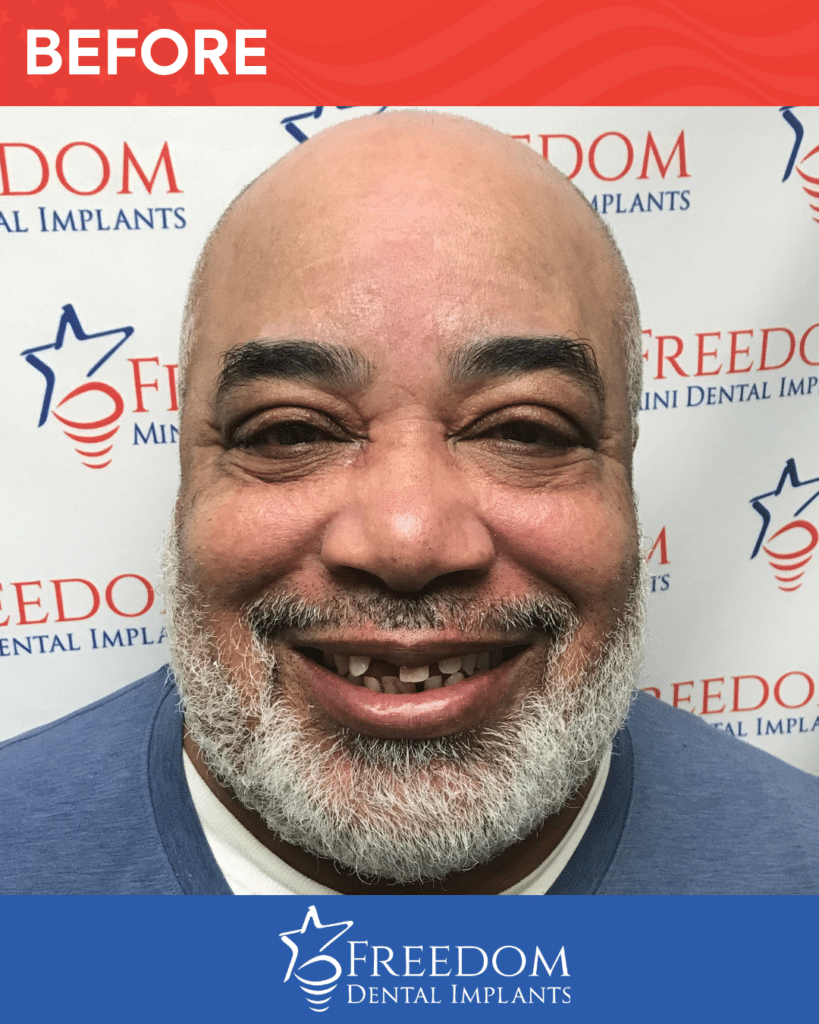

A smile from our practice. Individual results vary. Photos show the patient’s own starting point and result.
Patient education

Understand the healing stages after tooth extraction and how they affect the timing of mini implant placement.

Follow the main stages of mini implant treatment, from consultation and planning to your final restoration.

Learn when crowded, failing teeth may require extractions and how replacement options are planned.

We are a family-run practice, and you see Dr. Regan Ackerman from your first consultation through treatment. We recommend care for the teeth that need it and preserve healthy teeth whenever possible. We use both mini and conventional-sized one-piece implants, choosing the size and restoration that fit your mouth.
Contact us today to arrange a free consultation.
Let’s talk about your smile
Tell us what is holding you back. We will explain your options and help you take the next step with confidence.
Request a free consultation Call (502) 937-4930